The 99213 CPT code is one of the most frequently reported evaluation and management codes in physician offices and outpatient practices. It is commonly used for routine follow-up visits, stable chronic conditions, and acute uncomplicated problems involving established patients.
Although 99213 is widely used, it is also frequently misunderstood. Some providers select it based only on visit length, while others rely on outdated history and physical examination requirements. These approaches can result in undercoding, overcoding, claim denials, lost revenue, and compliance concerns.
Correct code selection requires more than confirming that a patient spent 20 minutes in the office. The provider must first determine whether the patient is established, confirm that the service occurred in an appropriate setting, and select the E/M level using either medical decision making or qualifying total time.
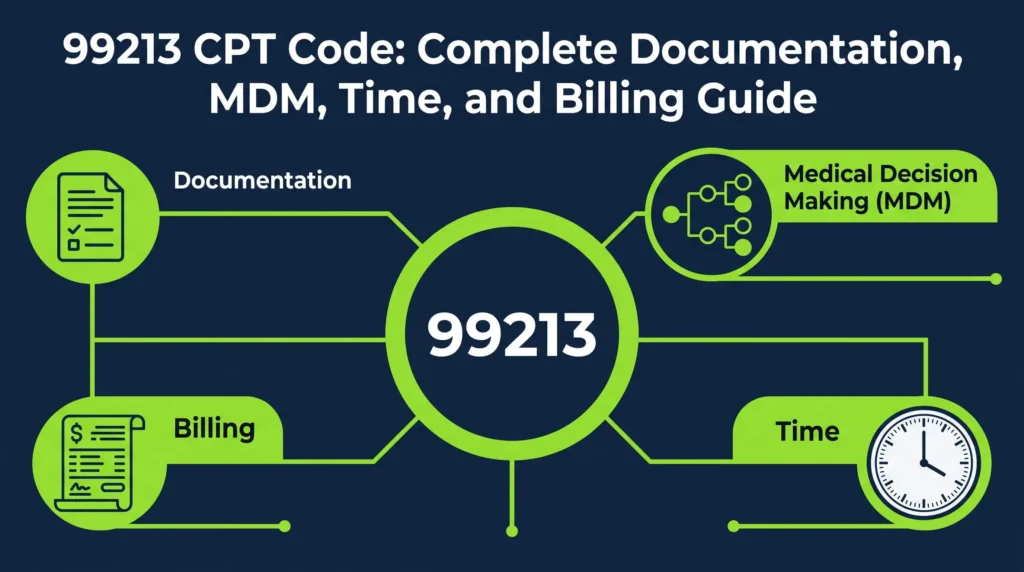
This guide explains the 99213 CPT code description, documentation requirements, medical decision-making criteria, time rules, reimbursement factors, telehealth use, modifier considerations, and common billing errors. It also compares 99213 with nearby E/M levels so practices can report the service more confidently.
What Is the 99213 CPT Code?
CPT code 99213 represents an office or other outpatient evaluation and management visit for an established patient. It requires a medically appropriate history and/or examination and a low level of medical decision making. When the provider selects the code based on time instead of MDM, the qualifying total time must be between 20 and 29 minutes on the date of the encounter.
The American Medical Association describes a typical 99213 patient as an established patient presenting with a stable chronic illness or an acute uncomplicated injury. These are examples rather than automatic coding rules. The actual code must reflect the documented work performed during each encounter.
99213 CPT Code at a Glance
Coding element 99213 requirement Patient status Established patient Setting Office or other outpatient location E/M level Level 3 established-patient visit Medical decision making Low Time-based range 20–29 total minutes History and examination Medically appropriate Code selection method MDM or total time Common comparison codes 99212 and 99214
The provider does not have to satisfy both low MDM and the 20–29-minute range. Office and outpatient E/M levels may generally be selected using either the documented MDM or the total qualifying time personally spent by the physician or qualified healthcare professional on the encounter date.
Who Qualifies as an Established Patient?
The word established has a specific coding meaning. A patient is generally established when the patient has received professional services during the previous three years from:
- The same physician or qualified healthcare professional; or
- Another physician or qualified healthcare professional of the same specialty and subspecialty in the same group practice.
Seeing a different specialty within the same organization does not automatically make the patient established for every department. Specialty, subspecialty, group affiliation, and previous professional services must be considered.
For example, a patient may be established with a family medicine physician but new to a dermatologist working in the same multispecialty organization. In contrast, a patient seen by another family medicine physician in the same group during the previous three years will generally remain established.
This classification matters because new patients are reported with codes 99202–99205 rather than 99212–99215.
How Is the 99213 Level Selected?
Current office and outpatient E/M rules allow the provider to choose between two methods:
- Medical decision making
- Total time on the date of the encounter
The provider should use the method that accurately reflects the service and is supported by the medical record. History and physical examination remain clinically important, but their length or number of documented elements does not determine the code level.
Older rules frequently required specific numbers of history elements, review-of-system entries, and examination bullets. Those element-counting requirements no longer control office and outpatient E/M code selection. The history and examination should instead be appropriate for the patient’s condition and the services performed.
Medical Decision Making Requirements for 99213
The 99213 CPT code requires low-level medical decision making when MDM is used for code selection.
Medical decision making contains three elements:
- Number and complexity of problems addressed
- Amount and complexity of data reviewed and analyzed
- Risk of complications, morbidity, or mortality related to patient management
The overall MDM level is based on the highest level supported by at least two of these three elements. A provider does not need to satisfy all three at the low level.
1. Number and Complexity of Problems Addressed
The low-level problems element may be supported by circumstances such as:
- Two or more self-limited or minor problems
- One stable chronic illness
- One acute uncomplicated illness or injury
- One stable acute illness
The full CPT MDM table includes additional circumstances, but these are among the most relevant examples for routine outpatient care.
A problem counts only when it is meaningfully evaluated or managed during the encounter. Listing a diagnosis in the assessment without addressing its status, treatment, testing, monitoring, or care plan does not necessarily mean the problem was addressed.
For example, copying diabetes, hypertension, and hyperlipidemia from the problem list does not automatically produce a higher code. The documentation should explain what the provider did with each relevant condition.
Useful documentation may include:
- Hypertension remains stable on the current treatment plan.
- Blood pressure is controlled based on today’s reading.
- Diabetes is stable without hypoglycemic episodes.
- Upper respiratory symptoms remain uncomplicated.
- An ankle sprain is improving with conservative care.
A chronic condition should not be labeled stable merely because it has existed for years. A condition may be considered unstable when it is poorly controlled, worsening, progressing, or failing to meet the intended treatment goal.
2. Amount and Complexity of Data Reviewed
The limited-data element for low MDM may be supported by either of the following categories:
Category 1: Tests and documents
Any combination of two qualifying items, such as:
- Reviewing an external note from a unique source
- Reviewing the result of a unique test
- Ordering a unique test
Category 2: Independent historian
An assessment that requires information from an independent historian may also satisfy the limited-data element.
An independent historian may be necessary when the patient cannot provide a complete or reliable history because of age, developmental status, cognitive impairment, language limitations, or another relevant circumstance.
Documentation should identify what information was reviewed rather than stating only “labs reviewed” or “records checked.”
A stronger entry might read:
Reviewed the basic metabolic panel completed on May 3. Renal function and potassium remain stable. Ordered a repeat panel before the next follow-up visit.
Specific documentation makes it easier for coders, auditors, and payers to understand the work performed.
Data used to select the E/M level should not be counted again when the provider separately reports another CPT service for the same interpretation or professional work. The same work cannot be used twice to support separate payments.
3. Risk of Patient Management
The third MDM element evaluates the risk associated with the management decisions made during the encounter. For 99213, the applicable level is generally low risk of morbidity from additional diagnostic testing or treatment.
Risk is based on the patient-specific management decision, not simply the diagnosis name. Two patients with the same condition may have different risk levels based on comorbidities, treatment options, age, symptoms, and the decisions made by the provider.
Documentation should show the plan and relevant reasoning. Examples may include:
- Continuing conservative treatment
- Recommending routine monitoring
- Advising over-the-counter treatment when clinically appropriate
- Ordering low-risk follow-up testing
- Referring the patient for nonurgent therapy or evaluation
- Continuing an existing care plan without a significant treatment change
Prescription drug management is identified as an example of moderate risk in the CPT MDM framework. However, one moderate-risk element does not automatically make the entire encounter 99214. Two of the three MDM elements must meet or exceed the moderate level before the overall MDM becomes moderate.
For example, a visit involving one stable chronic illness, minimal data, and prescription drug management may still fall below moderate MDM because only the risk element reaches the moderate level. The complete record must be evaluated rather than using a single factor as an automatic code trigger.
Using Time to Report CPT Code 99213
When time is used to select the E/M level, the provider must document 20–29 minutes of qualifying total time on the date of service.
This is total physician or qualified healthcare professional time, not only face-to-face time in the examination room. It may include qualifying work performed before, during, and after the patient interaction on the same calendar date.
Activities That May Count Toward Total Time
Qualifying activities may include:
- Preparing to see the patient
- Reviewing relevant records or test results
- Obtaining or reviewing a medically appropriate history
- Performing an examination or evaluation
- Counseling and educating the patient or caregiver
- Ordering medications, tests, or procedures
- Referring or communicating with other healthcare professionals
- Documenting clinical information in the health record
- Independently interpreting results when not separately reported
- Coordinating care when not separately billed
The provider should document the total time, such as:
Total physician time on the date of service was 24 minutes, including record review, patient evaluation, counseling, order entry, and documentation.
A minute-by-minute breakdown is not generally required. The record should identify the total qualifying time and provide enough information to support that it relates to the reported E/M service.
Time That Should Not Be Counted
Do not include:
- Time personally spent only by clinical staff
- Time related to separately billed procedures
- Time for services performed on another date
- Duplicate time when two professionals perform the same activity together
- Work already included in another separately reported service
The full time threshold must be met. A visit lasting 19 minutes does not qualify for 99213 based on time. It may still qualify based on low MDM, but the time method alone would not support it. CMS also confirms that the midpoint rule used for some timed services does not apply to these E/M code ranges.
Does 99213 Require a Detailed History or Physical Examination?
No fixed number of history or examination elements is required to support 99213 under current office and outpatient E/M rules.
The provider should perform and document a medically appropriate history and/or examination based on the presenting problem and clinical judgment. The extent of those services does not determine whether the encounter is 99212, 99213, or 99214.
Outdated guidance may still refer to:
- Expanded problem-focused history
- A certain number of HPI elements
- A specific number of review-of-system entries
- Six to eleven examination bullets
- The 4×4 examination method
Those older documentation thresholds should not be used as the basis for current office E/M level selection.
The note should instead focus on clinically meaningful details that support the problems addressed, data reviewed, management risk, or total time.
99213 Documentation Requirements
A compliant 99213 note should clearly communicate why the service was medically necessary and how the selected level was supported.
Patient and Encounter Information
Document:
- Patient identity
- Date of service
- Rendering provider
- Place or type of service
- Reason for the encounter
- Established-patient status when relevant
Condition Status
For every problem that contributes to MDM, describe its current status. Avoid listing diagnoses without context.
Instead of:
Diabetes.
Document:
Type 2 diabetes remains stable. Home glucose readings reviewed. No reported hypoglycemia. Continue the current plan and obtain an A1C before the next visit.
Data Reviewed or Ordered
Identify:
- The external note reviewed
- The specific test result reviewed
- The test ordered
- The source of outside information
- Why an independent historian was needed
Assessment and Plan
The plan should connect to the conditions addressed. Include relevant treatment decisions, monitoring, follow-up, referrals, education, and return precautions.
Total Time
When selecting 99213 based on time, document the total qualifying time on the encounter date. Total time is not required when the code is selected entirely by MDM.
Medical Necessity
Documentation quantity should not drive the code. A long templated note does not automatically justify 99213 or 99214. CMS identifies medical necessity as a central payment requirement and states that documentation should support the reported service rather than merely create volume.
Example of 99213 Documentation
The following is a simplified example for educational purposes:
Reason for Visit: Follow-up for stable hypertension.
History: Patient reports taking medication as directed. No dizziness, chest pain, shortness of breath, or new concerns.
Assessment: Hypertension remains stable. Blood pressure today is 126/78.
Data: Reviewed the metabolic panel from the previous month. Electrolytes and renal function remain stable. Ordered a repeat metabolic panel before the next follow-up.
Plan: Continue the current treatment plan. Reinforced home blood pressure monitoring, diet recommendations, and return precautions. Follow up in three months.
This encounter may support low MDM because one stable chronic illness is addressed and limited data is documented. Final code selection still depends on the complete record and applicable payer requirements.
Common Clinical Situations That May Support 99213
The following encounters may support the 99213 CPT code when the complete documentation meets low MDM or the 20–29-minute requirement:
Stable Chronic Condition Follow-Up
A patient returns for routine monitoring of a stable condition such as controlled hypertension, diabetes, asthma, or hypothyroidism. The provider assesses the condition, reviews relevant information, and continues the management plan.
Acute Uncomplicated Illness
An established patient presents with an uncomplicated respiratory infection, minor skin condition, or another short-term problem expected to resolve without functional impairment.
Minor Injury Follow-Up
A patient returns for evaluation of an improving sprain, uncomplicated fracture recovery, or superficial injury requiring routine monitoring.
Stable Acute Condition
A patient with a recently treated condition returns and is improving, although the problem has not completely resolved.
Routine Specialty Follow-Up
A specialist monitors an established patient whose condition is stable and whose encounter requires low MDM.
These scenarios are illustrations, not automatic code assignments. A familiar diagnosis should never be assigned the same E/M level across every visit. The work and decision making may differ from one encounter to the next.
99213 vs 99212
CPT 99212 represents a lower established-patient E/M level.
Feature 99212 99213
The AMA describes 99212 as requiring straightforward MDM or 10–19 minutes when selected by time.
The presence of a chronic diagnosis does not always guarantee 99213. The provider must address the condition in a way that supports low MDM, or the qualifying total time must fall within the 20–29-minute range.
99213 vs 99214
The distinction between 99213 and 99214 is a common source of coding errors.
Feature 99213 99214
CPT 99214 requires moderate MDM or 30–39 minutes when selected by total time.
Moderate problem complexity may include:
- One or more chronic illnesses with exacerbation, progression, or treatment side effects
- Two or more stable chronic illnesses
- One undiagnosed new problem with an uncertain prognosis
- One acute illness with systemic symptoms
- One acute complicated injury
Moderate risk may include prescription drug management, but prescription medication alone should not be treated as an automatic 99214. At least two MDM elements must meet or exceed the moderate level.
For example:
- Problems: Low
- Data: Low
- Risk: Moderate
This combination generally supports low overall MDM because only one element reaches moderate.
By comparison:
- Problems: Moderate
- Data: Low
- Risk: Moderate
This combination may support moderate MDM because two elements meet the moderate level.
Can 99213 Be Billed With a Procedure?
A provider may report 99213 on the same date as a procedure when the patient receives a significant, separately identifiable E/M service beyond the work normally included in that procedure.
When appropriate, modifier 25 is appended to the E/M code—not the procedure code. The medical record should clearly distinguish the separate evaluation and management work. A different diagnosis is not always required, but documentation must support the separate service.
Modifier 25 should not be added automatically whenever an office visit and procedure occur on the same day. Routine pre-service evaluation, consent, and post-procedure instructions included in the procedure are not enough to support a separate E/M charge.
Can CPT Code 99213 Be Used for Telehealth?
99213 may be reported for an eligible telehealth encounter when:
- The payer recognizes the service through telehealth
- The patient and provider meet applicable eligibility requirements
- The technology and service format meet payer rules
- The documentation supports low MDM or qualifying time
- The correct place-of-service code and modifier are reported
Telehealth coverage is not identical across Medicare, Medicaid, Medicare Advantage, and commercial plans. CMS maintains a year-specific list of services payable under the Medicare Physician Fee Schedule when furnished through telehealth. Practices should verify the current list and payer instructions for the date of service.
The same basic MDM and time principles apply, but telehealth billing rules may change independently of the CPT descriptor.
99213 Reimbursement
There is no single reimbursement amount for the 99213 CPT code.
Payment may vary based on:
- Medicare payment year
- Geographic locality
- Facility or nonfacility setting
- Payer contract
- Provider participation status
- Modifier use
- Place of service
- Multiple-procedure or bundling rules
- Quality or value-based payment adjustments
CMS calculates Physician Fee Schedule amounts using work, practice-expense, and malpractice RVUs adjusted by geographic practice cost indices. The CMS PFS lookup tool allows practices to review payment information by code, year, and locality.
Commercial insurers may pay more or less than Medicare depending on the provider’s contract. Therefore, articles that present one universal 99213 reimbursement rate can be misleading.
Practices should maintain updated fee schedules and compare:
- Billed charges
- Contracted allowable amounts
- Actual payer payments
- Patient responsibility
- Adjustment and denial patterns
This analysis can help identify underpayments and payer configuration problems without encouraging inappropriate code selection.
Common 99213 Billing and Documentation Mistakes
Selecting the Code by Diagnosis Alone
There is no automatic E/M level for hypertension, diabetes, hearing loss, asthma, or another diagnosis. The code reflects the service performed during that encounter.
Using Outdated History and Examination Rules
Do not require problem-focused history labels, ROS counts, or examination bullets to determine the office E/M level.
Assuming 20 Minutes Always Means 99213
Twenty minutes may support 99213 when it represents qualifying total time and is properly documented. Time spent by clinical staff or on a separately reported procedure should not be included.
Failing to Document Condition Status
A diagnosis list does not explain whether a condition is stable, improving, worsening, or actively managed.
Vague Data Statements
“Labs reviewed” does not identify the unique data considered. Name the relevant test, result, date, or external source.
Counting Problems Not Addressed
A problem should not be counted merely because it appears in the medical history or problem list.
Automatically Assigning 99214 for Prescription Medication
Prescription drug management may support moderate risk, but the overall MDM still depends on two of three elements.
Using Modifier 25 Without Separate Work
A same-day procedure does not automatically justify a separately payable E/M service.
Copying Old Documentation
Copied text may create contradictions, outdated findings, and unsupported conditions. Every note should accurately reflect the current encounter.
Ignoring Medical Necessity
The documented service must be reasonable and necessary. Meeting a technical checklist does not replace medical necessity.
Best Practices for Accurate 99213 Claims
Medical practices can improve 99213 coding accuracy by building a consistent workflow:
- Confirm whether the patient is new or established.
- Verify that the office or outpatient code family is appropriate.
- Decide whether MDM or time will support code selection.
- Document the status of every problem addressed.
- Identify specific data reviewed, analyzed, or ordered.
- Record the management decisions and related risk.
- Document total time when using time-based coding.
- Remove outdated history and examination counting requirements from templates.
- Review same-day services for modifier and bundling rules.
- Check current payer requirements before claim submission.
- Audit patterns rather than reviewing only isolated claims.
- Educate providers when documentation and selected levels do not align.
Internal audits should look for both overcoding and undercoding. Consistently reporting 99213 for every established-patient visit may be as inaccurate as frequently billing 99214 without support.
How Medical Billing Services 1 Supports Accurate E/M Billing
Managing E/M documentation, payer edits, modifiers, claim submission, and denial follow-up can place a significant administrative burden on healthcare practices.
Medical Billing Services 1 (MBS1) supports practices seeking a more organized medical billing process. Accurate 99213 billing requires coordination between clinical documentation, coding, charge entry, claim edits, and payer follow-up. A weakness at any stage may delay payment or result in an unnecessary denial.
An effective billing workflow should help a practice:
- Identify coding and documentation inconsistencies
- Submit cleaner claims
- Follow payer-specific billing requirements
- Review modifier use
- Track denials and underpayments
- Recognize recurring revenue-cycle issues
- Provide feedback for future documentation improvement
The goal should never be to push every encounter to a higher level. The goal is to report the level that accurately represents the medically necessary service and is supported by the record.
Frequently Asked Questions About the 99213 CPT Code
What does the 99213 CPT code mean?
It represents an established-patient office or other outpatient E/M visit requiring low-level MDM. When time is used for selection, the provider must document 20–29 minutes of qualifying total time.
Does exactly 20 minutes qualify for 99213?
Yes. Twenty minutes meets the minimum time requirement when the documented time is qualifying physician or QHP time on the date of the encounter.
Can a 15-minute visit be billed as 99213?
It cannot qualify through the time method because 15 minutes falls below the 20-minute threshold. It may still qualify when the documentation supports low MDM.
Is 99213 only for primary care?
No. Physicians and qualified healthcare professionals in different specialties may report it when the code, scope-of-practice, payer, and documentation requirements are met.
Is a physical examination mandatory?
The code requires a medically appropriate history and/or examination. The extent is determined by clinical judgment, and specific examination bullet counts do not determine the level.
Is 99213 used for new patients?
No. It is an established-patient code. New-patient office visits generally use codes 99202–99205.
Can a medication refill support 99213?
Possibly. The provider must perform a medically necessary E/M service and document the relevant problem assessment and management. A refill request by itself does not automatically establish a particular code.
Can 99213 be reported more than once for the same patient?
The CPT descriptor does not establish a general frequency limit. Each service must be medically necessary, distinct, properly documented, and consistent with payer policies. Same-day or unusually frequent services may receive additional payer review.
Is 99213 payable with modifier 25?
Modifier 25 may be appended when a significant, separately identifiable E/M service is performed on the same day as another procedure or service. Documentation must show work beyond the usual procedure-related evaluation.
What is the main difference between 99213 and 99214?
99213 requires low MDM or 20–29 minutes. CPT 99214 requires moderate MDM or 30–39 minutes.
How much does Medicare pay for 99213?
The payment varies by year, locality, setting, and other factors. Use the current CMS Physician Fee Schedule and applicable Medicare Administrative Contractor information rather than relying on one national estimate.
Final Takeaway
The 99213 CPT code is appropriate for an established-patient office or outpatient encounter supported by low-level medical decision making or 20–29 minutes of qualifying total time.
Accurate reporting depends on four fundamentals:
- Correctly identifying the patient as established
- Selecting the code through MDM or time
- Documenting clinically meaningful details
- Confirming medical necessity and payer requirements
Providers should not use old history and examination counting rules, select the level based only on a diagnosis, or assume every routine follow-up is automatically 99213. Each encounter should be evaluated on its own facts.
Clear documentation protects the practice, improves communication among care teams, supports cleaner claims, and helps patients and payers understand the services delivered. With a consistent workflow and reliable billing support from Medical Billing Services 1, practices can reduce avoidable errors while maintaining compliant and accurate E/M billing.