Gastroenterology Medical
Billing Services
Gastroenterology billing fails where it matters most, screening colonoscopies converting to diagnostic without modifier PT, polyp removal techniques billed under wrong CPT codes, and ERCP bundling violations silently draining your gastroenterology revenue cycle management. MBS1’s certified gastroenterology billing services fix every gap.

End-To-End Gastroenterology Revenue Cycle Management Services
Gastroenterology Billing Services
Every colonoscopy conversion, every polyp removal technique, and every ERCP bundling rule represents a billing decision that either captures your full reimbursement or quietly surrenders it. MBS1's gastroenterology billing services ensure every decision lands correctly every single time.
- Colonoscopy and Endoscopy Pre-Authorization
- Daily Clean Gastroenterology Claims Submission
- Faster GI Reimbursement Timelines
- Denial Recovery and Appeal Filing
- ERA and EOB Payment Reconciliation
- Outstanding AR Recovery and Follow-Up
Gastroenterology Credentialing Services
Every day your gastroenterologist operates outside active payer enrollment means colonoscopies, ERCPs, and infusion therapy sessions your practice performs but cannot bill for. MBS1 credentials your GI providers completely, accurately, and without revenue-costing delays.
- Medicare and Medicaid GI Provider Enrollment
- Commercial Insurance Panel Credentialing
- CAQH Profile Creation and Maintenance
- GI Provider Re-Credentialing and Revalidation
- NPI Setup and Profile Management
- Multi-State Gastroenterology Provider Enrollment
Gastroenterology RCM Services
Gastroenterology revenue cycle management breaks at the procedure level — one wrong polyp removal technique code, one missed modifier 33 on an ACA-mandated preventive colonoscopy, and one ERCP component incorrectly bundled compounds across every high-volume endoscopy case your practice performs weekly.
- GI Patient Demographics and Eligibility
- Colonoscopy and Procedure Benefits Verification
- Charge Capture and Pre-Submission Scrubbing
- GI Claim Filing and Status Monitoring
- Denial Resolution and Management
- Patient Balance and Payment Collections
Gastroenterology Coding Services
A screening colonoscopy that converts to diagnostic without modifier PT applied correctly, a snare polypectomy coded identically to a cold biopsy forceps removal, and a capsule endoscopy claim missing its prior authorization documentation, these are the silent revenue losses your gastroenterology practice absorbs daily without a single denial making the pattern obvious.
- Colonoscopy Conversion and Modifier PT Coding
- Polyp Removal Technique-Specific CPT Coding
- Modifier Application and Accuracy Review
- ERCP and Upper GI Endoscopy Coding
- Infusion Therapy and Biologic J-Code Coding
- ICD-10 Precision and ASGE Guideline Compliance
Why Gastroenterology Practices Choose MBS1
Gastroenterology practices require a medical coding company that understands the difference between a cold biopsy forceps removal and a snare polypectomy is not just clinical, it is a completely different CPT code, a different reimbursement value, and a different compliance obligation that must be captured precisely on every single case.
- Our certified gastroenterology billing team understands every colonoscopy conversion rule, polyp removal technique code, and ERCP bundling requirement your practice encounters daily.
- You get a dedicated GI billing specialist assigned personally who knows your procedure mix, your payer contracts, and your specific denial patterns from the very first month.
- Complete GI financial visibility: Real-time dashboards and monthly reports break down collections by procedure type, polyp removal technique, denial patterns by CPT category, and AR aging by service line.
- Transparent gastroenterology billing pricing with zero setup fees, zero long-term commitments, just straightforward rates built around what your GI practice actually collects.

The Math Behind
the Momentum

When Your GI Practice Runs Right, Everyone Wins
Gastroenterologists perform procedures that detect cancer before it starts, diagnose conditions that have been misunderstood for years, and deliver infusion therapies that give IBD patients their lives back. When gastroenterology revenue cycle management runs without friction behind that clinical work, your team stops fighting denied colonoscopy claims and starts investing in the diagnostic capabilities your patients deserve. Your practice collects what it earns, operates with financial confidence, and builds the foundation to serve more patients without billing complexity limiting everything your GI team is capable of achieving.
Compliance Built Around GI Billing Guidelines
Gastroenterology billing guidelines change with ASGE documentation standards, ACA preventive service requirements, and annual CPT updates that directly affect colonoscopy, ERCP, and capsule endoscopy reimbursement. MBS1 builds compliance into every gastroenterology claim from charge entry through final submission, ensuring modifier 33 is applied correctly on every ACA-mandated preventive colonoscopy, every ERCP component is checked against current NCCI bundling edits, and every IBD biologic infusion meets prior authorization and medical necessity documentation requirements. We operate under full HIPAA and HITECH compliance with encrypted PHI handling throughout. Your gastroenterology practice stands audit-ready at every stage.


Revenue Intelligence That Reveals What Your GI Practice Is Actually Losing
Most gastroenterology practices cannot identify which procedure types generate the highest denial rates, which payers consistently underpay on ERCP claims, or how much polyp removal revenue disappears through incorrect technique-specific code selection every single month. MBS1 delivers real-time financial dashboards built specifically around gastroenterology billing performance, breaking down collections by endoscopy procedure type, colonoscopy conversion accuracy, denial patterns by CPT category, and AR aging by service line. Every report surfaces the exact revenue intelligence your GI practice needs to correct systematic underbilling before it compounds further.
Gastroenterology Billing Solutions That Grow With Your Practice
Whether you run a solo gastroenterology practice, a multi-provider GI group, a hospital-based endoscopy program, or a dedicated infusion center managing IBD patients daily, MBS1 scales its gastroenterology billing solutions around your procedure volume, endoscopy mix, and payer requirements without compromising coding accuracy or ASGE guideline compliance at any stage of your practice growth.
The Real Reason To Outsource Gastroenterology Billing Services To MBS1
Gastroenterology billing is too technique-specific, modifier-dependent, and ASGE-guideline-driven to trust to any billing company that cannot tell a snare polypectomy from a submucosal injection removal without looking it up.
✓ Higher Gastroenterology Revenue Collection
✓ Faster Endoscopy Claim Processing
✓ Fewer Colonoscopy Coding Errors
✓ More Predictable GI Revenue Cycle
✓ Better ASGE and HIPAA Compliance
✓ Lower Operational and Staffing Costs
✓ Reduced Administrative Burden on Staff
✓ Better Focus on GI Patient Care
✓ Reduced Risk of Staff Shortage Issues
✓ Less Gastroenterology Billing Training Required

The Gastroenterology Billing Process MBS1 Follows

Verify Before the Scope Goes In
We confirm patient eligibility, colonoscopy benefits, preventive versus diagnostic coverage, and prior authorization requirements for capsule endoscopy and biologic infusions before every GI procedure is performed.

Code Every GI Procedure With Technique-Level Precision
Our certified gastroenterology medical coding company team assigns exact colonoscopy conversion codes, polyp removal technique-specific CPT codes, ERCP components, and ICD-10 specificity directly from procedure documentation and pathology correlation.

Scrub Every Claim Against GI Billing Rules
Every claim is checked against NCCI bundling edits, ASGE documentation requirements, modifier 33 and PT application rules, and payer-specific gastroenterology billing guidelines before electronic submission within 24 hours.

Recover, Reconcile, Report
Denied GI claims are worked within 72 hours, ERCP underpayments disputed, and monthly dashboards show clean claim rates and denial patterns broken down by endoscopy procedure type and payer.
Is Your Gastroenterology Practice Losing Revenue Silently?
Gastroenterology revenue erosion is procedure-specific and cumulative — one missed colonoscopy conversion modifier, one incorrectly coded polypectomy technique, and one ERCP component incorrectly bundled per week adds up to significant monthly revenue loss that never generates a clear denial alerting your team to the problem.
- High denial rates on PCI and echo claims
- Missing or expired prior authorizations
- Incorrect modifier usage on procedures
- Unbundled cardiology procedure codes
- Aging AR over 90 days unresolved
- In-house staff overwhelmed with billing
- Credentialing delays blocking new providers
- No visibility into revenue cycle performance
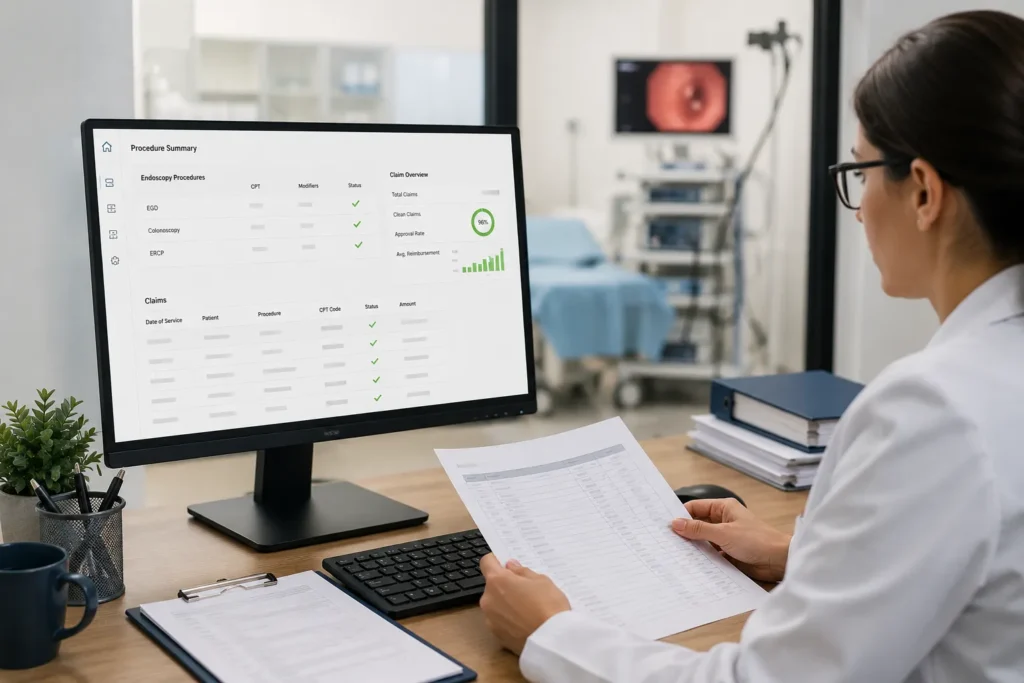
AI-Powered Gastroenterology Billing Built For Endoscopy Complexity
Gastroenterology billing generates more technique-specific coding variables per procedure than almost any other outpatient specialty, colonoscopy conversion rules, polyp removal technique selection, ERCP component billing, and biologic infusion J-code tracking all running simultaneously across every endoscopy case. MBS1 applies AI-powered claim scrubbing and real-time NCCI edit validation built specifically for gastroenterology billing complexity, catching modifier errors and technique miscoding before any claim reaches a payer.
Gastroenterology Practice Management, Simplified
Managing a gastroenterology practice means coordinating high-volume endoscopy scheduling, capsule endoscopy prior authorization tracking, IBD infusion therapy appointments, pathology correlation workflows, MIPS quality reporting deadlines, and credentialing timelines simultaneously. MBS1 consolidates your entire gastroenterology revenue cycle management under one dedicated team that understands GI billing inside out so your gastroenterologists focus entirely on the diagnostic and therapeutic excellence your patients depend on.

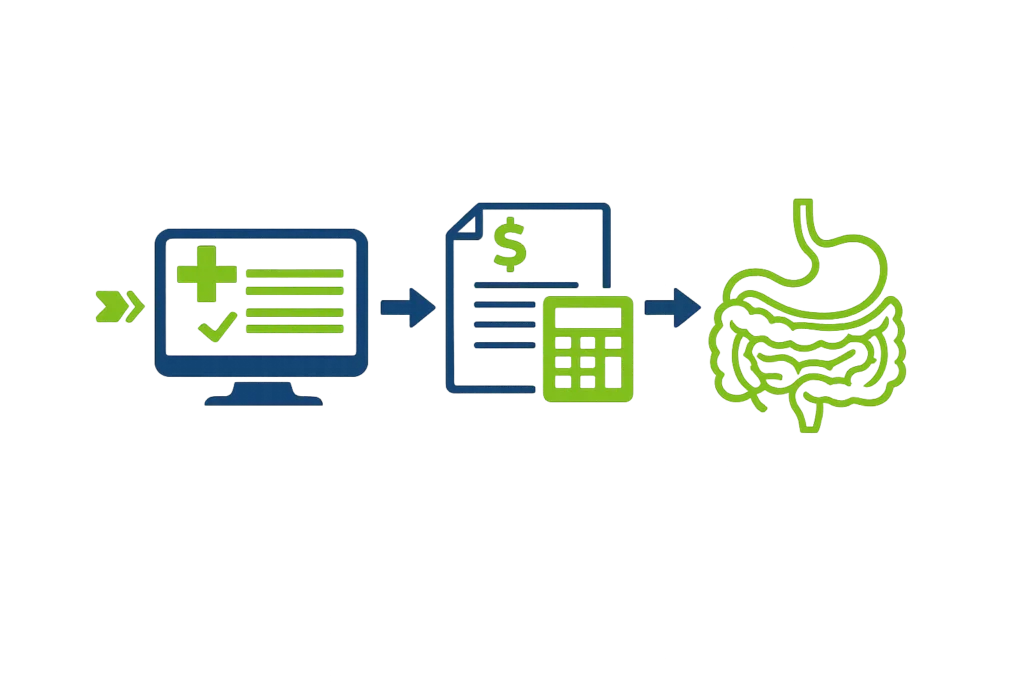
Seamless EHR / EMR Billing Services For Gastroenterology Practices
Your gastroenterology practice already operates on systems your clinical and administrative teams know, MBS1 integrates directly with gGastro, Modernizing Medicine, Epic, athenahealth, and eClinicalWorks without disrupting endoscopy documentation workflows, pathology correlation processes, or charge capture accuracy from the very first claim submitted on your behalf.
#1 Gastroenterology Medical Billing Company In USA
Ask the Practices We've Helped
“We were losing money on every colonoscopy conversion and had no idea the modifier PT requirement even existed. MBS1 identified it in our free audit and our GI collections improved significantly within weeks.”
— Dr. Robert Hensley, Gastroenterologist
Claim Your Free Gastroenterology Billing Audit
Most gastroenterology practices undercollect through colonoscopy conversion miscoding, polyp removal technique errors, and ERCP bundling violations that compound across every endoscopy session weekly. For one complete month, MBS1 audits your entire gastroenterology billing operation at zero cost, identifying every coding gap, modifier error, and revenue leak specific to your procedure mix and payer contracts. No commitment. No contracts. Just answers your GI practice needs.

Frequently Asked Questions
Gastroenterology medical billing is the process of coding, submitting, and managing insurance claims for digestive system services, from colonoscopies and ERCPs to capsule endoscopy and IBD biologic infusions, ensuring gastroenterologists receive accurate and complete reimbursement for every procedure performed.
Gastroenterology billing involves screening to diagnostic colonoscopy conversion coding, polyp removal technique-specific CPT selection, ERCP bundling compliance, modifier 33 for ACA preventive services, capsule endoscopy prior authorization, and biologic infusion J-code billing, creating more procedure-specific coding variables per encounter than most outpatient specialties.
A screening colonoscopy uses CPT 45378 and modifier 33 for ACA-mandated preventive services with no patient cost-sharing. When a screening colonoscopy converts to diagnostic during the procedure — such as when polyps are removed — modifier PT must be applied to correctly identify the converted service and maintain appropriate patient cost-sharing and reimbursement levels.
Polyp removal coding depends entirely on the technique used during the procedure. Cold biopsy forceps uses 45380, submucosal injection uses 45381, control of bleeding uses 45382, hot biopsy forceps uses 45384, and snare technique uses 45385. Each technique is a separately reportable service, billing the wrong technique code or grouping multiple techniques under one code is a consistent source of GI revenue loss.
ERCP billing uses CPT codes 43260 through 43278, where the specific code depends on the endoscopic intervention performed. Multiple ERCP components performed during the same session follow complex NCCI bundling rules that determine which services are separately billable. We verify every ERCP component against current bundling edits before submission to ensure maximum compliant reimbursement on the highest-value GI procedure.
We bill every biologic infusion with the correct J-code per specific drug administered, alongside infusion administration codes, prior authorization documentation, and medical necessity diagnosis codes. Missing J-codes, incorrect infusion time documentation, or inadequate medical necessity support are the most common denial triggers on IBD biologic claims.
Modifier 33 identifies ACA-mandated preventive services that must be provided to patients with no cost-sharing under the Affordable Care Act. In gastroenterology, modifier 33 applies to screening colonoscopies for average-risk patients. Failing to apply modifier 33 correctly results in incorrect patient billing and potential ACA compliance violations that expose the practice to significant regulatory risk.
ASGE documentation guidelines establish the clinical documentation standards required to support gastroenterology procedure coding and medical necessity. Compliance with ASGE guidelines protects your practice during payer audits, supports modifier application, and ensures that complex GI procedures like capsule endoscopy and ERCP are documented to the standard required for maximum reimbursement.
Capsule endoscopy uses CPT 91110 for small intestine and 91111 for esophagus, with prior authorization required by most commercial payers. We manage the complete capsule endoscopy billing process including prior authorization submission, technical versus professional component billing where applicable, and medical necessity documentation that meets payer-specific LCD requirements.
Look for certified GI-specific coders with proven colonoscopy conversion expertise, polyp removal technique coding accuracy, ERCP bundling compliance knowledge, modifier 33 and PT application experience, ASGE guideline familiarity, transparent reporting, and seamless integration with gastroenterology-specific EHR platforms like gGastro and Modernizing Medicine.
Yes. MBS1 handles complete provider credentialing with Medicare, Medicaid, and all commercial payers alongside your gastroenterology billing services, ensuring every gastroenterologist and GI APP in your practice stays enrolled, compliant, and billable without revenue interruptions.
Yes. MBS1 integrates seamlessly with gGastro, Modernizing Medicine, Epic, athenahealth, and eClinicalWorks without disrupting endoscopy documentation workflows or pathology correlation processes from day one.
MBS1 leads as a specialized gastroenterology billing company combining certified GI coders, colonoscopy conversion expertise, ERCP bundling compliance, and dedicated account management across all GI practice types nationwide. Other notable gastroenterology billing companies include BSI Medical Billing, AnnexMed, Medusind, and GI Billing Group.
Outsourcing eliminates salaries, training, and software costs while delivering certified GI billing expertise that improves colonoscopy coding accuracy, reduces ERCP bundling violations, captures missed biologic J-codes, and accelerates reimbursements, typically saving gastroenterology practices 30 to 40 percent in operational billing costs.
Gastroenterology-specific MIPS quality measures include colonoscopy interval documentation, adenoma detection rate reporting, IBD therapy assessment, and appropriate follow-up for abnormal findings. Poor MIPS performance results in Medicare payment reductions while strong performance earns bonus payments that directly improve your GI practice revenue.